Strategic foundation · 19 October working reportFive findings. Three barriers. One Brunei skills baseline.See the original thesis alongside what Day 2's morning evidence adds.
20 OCTOBER · FORMAL CLOSING / COMPLETEDJobs must be created, training must connect to hiring, and 2030 delivery must be financed and measured.
NEW · FORMAL CLOSING / POLICY TRANSLATIONPhilippine host reflections · Thai labour-leadership message · emerging recommendations. Not an adopted communiqué.
EVIDENCE COMPOSITION / ACTUAL COUNTS
Which voices are represented?
Labour & just transition
3
Policy frameworks
1
Enterprise / mobility
1
Industry workforce
1
Finance & skills
1
Counts reflect the seven uploaded Day 1 PDFs, not forum programme completeness or ASEAN performance.
03 / PROVEFollow employment and transition outcomes.
Job relevance, inclusion, worker protection.
THE POLICY TEST FOR BRUNEIWhat investments will create demand — and which institutions can deliver the skills, with evidence?
02 · Source-led strategic assessment / 19 October
Day 1 thesis. Day 2 test.
The Day 1 recorded-session synthesis provides the analytical foundation. The final-session synthesis adds coordination, financing and implementation responsibilities.
The strategic proposition · Day 1 report, Part 1
Not simply more green qualifications. One linked investment–skills–employment system.
THE POLICY ARCHITECTUREANALYST MODEL
Source: Day 1 executive strategic summary and cross-cutting analysis. Conceptual, not measured performance.
DECISION LENS / BRUNEI
Build the workforce around real demand.
Validate projects and occupations; then test institutional capacity and measurable job outcomes.
Five findings. Three constraints. One proposed baseline.
These are qualitative connections, not confirmation of a Brunei capability score or proof that all five Day 1 conclusions have been independently validated. Day 2 afternoon slides and formal closing are now indexed; specific roundtable claims retain their stated validation caveats.
Recommended JPT starting point · proposal only
Green–Digital Skills Alignment Baseline
01 / DEMANDOccupations identifiedWhich projects and employers?
02 / CAPABILITYInstitutional baselineWho is ready to deliver?
03 / RESPONSETraining adjustmentsWhich modules or partnerships?
04 / OUTCOMESMeasures agreedWhat jobs and competencies result?
Source: Day 1 report, Part 4. Use existing datasets and HEI–industry consultation where authorised; do not assume connected national workforce forecasting already exists.
Coverage discipline: This original Day 1 report used two distinct recorded sessions (Parallel 3 and Plenary 3), not the entire forum. The additional seven presentation decks are separate documentary evidence. Day 2 slides received by 3 PM cover Plenary 4 and roundtable facilitation, but not validated table reports or afternoon discussion outcomes. Analysis and JPT proposals are not adopted policy.
03 · STRATEGY COMMAND / NATIONAL POLICY INTELLIGENCE
The decision architecture.
Four analytical views. One delivery question: how will investment translate into capabilities, decent work and measurable national outcomes?
BRUNEI STRATEGY COMMANDNational decision frame
Translate forum intelligence into policy choices.
This command view reframes the forum from information-sharing into a ministry-grade delivery logic: validate employer demand, test institutional capability, and monitor whether outcomes become real jobs and safe worker transitions.
ANALYTICAL VIEWS04System · gaps · ownership · roadmapDELIVERY NODES06Demand to quality employment chainMILESTONES05Illustrative Brunei sequence to 2030SOURCE BASE22Slides and forum evidence sets
National strategy workspaceFour interactive analytical lenses · source-linked evidence
Analytical decision supportProposed Brunei applications are not government decisions; diagrams show relationships, not readiness scores or forecast jobs.
SYSTEM VIEW / VALUE CREATION
Investment does not automatically become employment.
SELECT A NODE FOR THE POLICY TEST
01 / 06Sector investmentSTRATEGIC TEST
Leadership question
Which validated sector projects have the ability and intention to hire?
Minimum evidence
Project pipeline, employer confirmations, job numbers where supported, and investment timing.
Identify demand evidence, map existing qualifications and technical capability, and document critical gaps rather than launch a new national system immediately.
DECISION GATE
Proceed only where employer evidence and institutional ownership can be verified.
EVIDENCE STANDARD Every diagram distinguishes sourced forum findings, analytical connections and proposed national options.Read full supporting assessment ↗
03 · Analytical architecture
A framework for delivery.
One policy logic across two thematic dialogues. It is proposed analysis—not an adopted joint ASEAN framework.
01 / ALIGNMENTPolicy & investment
→
02 / TRANSFORMATIONTasks, standards & capacity
→
03 / OUTCOMESQuality employment
Strategic premise: One diagnostic chain, not another policy body. Sector priorities should be tested against real occupations, delivery capacity and verifiable results.
Explore the six-stage evidence chain
Interactive diagnostic
Selected stage · 01
Sector investment
Start with committed projects and credible industrial activity, rather than a sector label alone.
Evidence test:Which investments, timelines and employers can be substantiated?
Supporting source: D1-07 (ADB), slides 2–4.
Interpretation boundary: Neither concept note establishes the two dialogues as a formally integrated programme. This is a proposed cross-dialogue diagnostic to assess what Brunei can learn, contribute and implement.
04 · National application / Brunei Darussalam
Brunei relevance.
Not another abstract strategy: a structured test of existing policy, institutional assets, labour-market evidence and outcomes.
NATIONAL TRANSLATION / BRUNEI DARUSSALAM
The Brunei strategic pathway
FROM NATIONAL STRATEGY → TO QUALITY JOBS AND RESILIENT CAPABILITY
PROPOSED CROSSWALK, NOT AN EXISTING LINKED GOVERNMENT DATASET OR AUTHORISED PLATFORM INTEGRATION. CERMIN tracks HEI personnel, not whole-economy vacancies.
01 · VALIDATESector-specific demandWhat employers genuinely need, and when
03 · PILOTFocused pathwaysConsider aquaculture, monitoring or energy
04 · MEASUREWorkforce outcomesNot attendance or course count alone
Brunei system view
Visual strategic summary
P
Policy anchor
Wawasan 2035 and diversification define the opportunity space.
M
Market proof
Use employer demand, projects and occupations as the starting filter.
C
Capability check
Test whether HEI and TVET assets are genuinely ready to respond.
O
Outcome lens
Track jobs, access, placement quality and worker benefit.
B
Blue–green logic
Find overlap without forcing every sector into the same model.
D
Data boundary
Existing systems can help, but they do not yet form one unified labour-market platform.
Question AWhere is demand?Validated projects, firms and timings.
Question BWhat work changes?Occupations, tasks and standards.
Question CWho can deliver?Programmes, trainers, facilities and assessment.
Question DWhat proves success?Graduate and worker outcomes.
Analytical framing only. Capability roles and linkages require validation with HEIs and authorised datasets.
Brunei · evidence-to-delivery diagnostic
Proposed JPT testing framework · not an approved programme
1 · Confirm marketInvestment and employer commitments, with timeframes.
2 · Translate demandISCO/tasks and employer-validated skills taxonomy.
3 · Test readinessCurricula, trainers, labs, industry links and outcomes evidence.
4 · Pilot responseFocused pathway and graduate/worker outcome tracking.
Sources: GIZ slides 3, 6 and 8; ILO slides 3–5; SEAMEO GERI slides 4–6 and 12; TESDA slides 5–11. Local capacity and sector demand require Brunei-specific verification.
National capability map
Public HEIs · preliminary analytical positioning
Select an institution to view documented or provisional roles
UBD
Likely marine and aquaculture research anchor. Verify active projects, facilities and industry uptake before formal use.
Roles are an analytical capability map drawn from previous Brunei dialogue preparation; they are not formal institutional assignments. Confirm with HEI focal persons.
Existing evidence architecture
Different systems, different questions
HL
HiED Lens
Programme supply, enrolment and graduate evidence.
GE
GES / ESS
Graduate and employer outcome signals.
CE
CERMIN
HEI staff capability and workforce planning.
DG
Governance
Any linkage needs rights, quality controls and approval.
Potential sector demonstrators
Proposals, not selected government pilots
AQ
Sustainable aquaculture
Research, technicians, aquatic health and placements.
CM
Coastal monitoring
Sensors, data, AI and environmental observation.
EN
Low-carbon energy
Maintenance, controls, commissioning and reskilling.
PL
Pilot logic
Use one or two demonstrators before scaling broader claims.
Data-governance boundary: HiED Lens and GES/ESS can support education and outcome evidence. CERMIN supports HEI workforce planning. None alone provide a full labour-market system.
NEW · CLOSING SESSION / BRUNEI–BLUE BRIDGEFrom marine priorities to identifiable work and skills.
Closing-session discussion exposed an under-examined connection between ecosystem services, agricultural/marine work and the green transition. This is an analytical entry point for the coming ASEAN–EU Blue Economy dialogue, not an ASEAN-endorsed or government-approved pilot.
Investment, sectors, firms and just-transition concerns.
D2
Day 2 emphasisCan systems deliver?
Skills intelligence, readiness and implementation discipline.
BN
Brunei readUse a diagnostic lens.
Turn the two days into a small set of verification questions.
→
Decision cuePilot before scale.
Target credible sectors first, then track outcomes.
01 / GIZ · POLICY
Policy readiness does not equal implementation.
Regional frameworks have strengthened, but enterprise support, skills, active labour-market policy and social protection need attention.
D1-01 · slides 12–23
02 / ADB · CAPITAL
Connect finance to real occupations.
Investment examples in transport, energy and agrifood show why training demand should follow project and value-chain analysis.
D1-07 · slides 2–4, 7
03 / ABOITIZPOWER · INDUSTRY
Technical and digital skills now intersect.
Energy jobs increasingly blend technical, digital and operational skills.
D1-06 · slides 4–7
04 / KSBSI · FFW · ASETUC
Worker protection must be designed in.
Just transition requires worker voice, paid reskilling and protection.
D1-03, D1-04, D1-05
05 / ADB · SKILLS
Generic sustainability training is insufficient.
Green competencies must be occupation-specific and upskillable.
D1-07 · slides 3–7; study forthcoming
06 / VINFAST · EVS
Mobility shifts require transition planning.
EVs shift demand toward electrical, battery, software and data skills.
D1-02 · slides 4–8
These six cards reflect the seven uploaded decks. Some decks contain company forecasts, unpublished survey research or context-specific statistics. Treat those claims as speaker-reported until verified.
20 OCT 2026 · PLENARY 4 + THREE POLICY ROUNDTABLES
From green jobs to delivery capacity.
Eight slide decks now allow a source-checked reading of the morning evidence and the three roundtable agendas. Discussion outcomes are not yet supplied.
01 · MEASURE DEMAND02 · TEST CAPABILITY03 · DESIGN RESPONSE
EVIDENCE SNAPSHOT / 15:0095 slide pages. 4 plenary lenses. 3 roundtables.Historic 15:00 snapshot: 8 PDFs + 1 worksheet. Seven subsequent source PDFs and the closing transcript were added to the final two-day edition.
~1%Current green occupations · narrow bound
22%Potential occupations · broad bound
6.7%Green talent among hires · six-AMS sample
1.53 / 4Philippine GERI · 8 selected institutions
Four presentations. One implementation problem.
Original slides · Plenary 4
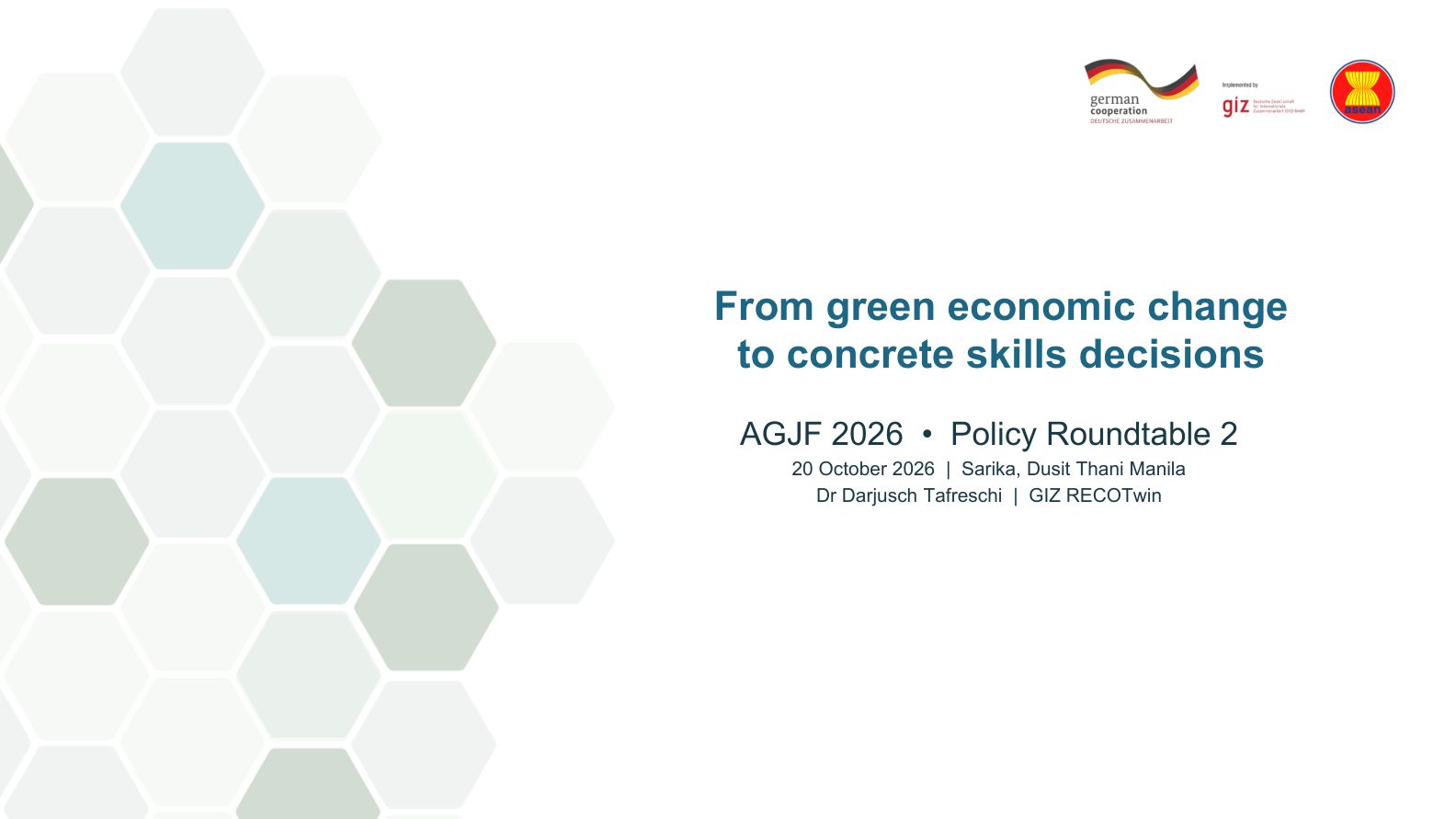
GIZ / RECOTWIN01
Demand and supply
Green potential is far larger than current green-job employment.
Evidence-control notice: These are presentation decks and roundtable instructions, not a record of agreed outcomes. GIZ estimates 22% green potential / 6.7% green-talent share of all hires; a GERI overview slide uses ~24% and ~14% with different or unclear populations. This edition uses the dedicated GIZ figures for those indicators and does not treat the figures as directly interchangeable. Brunei GERI results remain unvalidated. Actual roundtable recommendations require the reporting workbooks or transcripts.
Brunei · demandWhich priority sector investments imply real occupations?
Brunei · intelligenceWhich tasks and skills can be substantiated?
Brunei · capabilityWhat can each HEI/TVET provider actually deliver?
Brunei · outcomesHow will work, inclusion and employment quality be measured?
ANALYTICAL SYNTHESIS · NOT A FORMALLY ENDORSED ASEAN ACTION LIST
01 Economic opportunity
02 Occupational intelligence
03 HE / TVET capability
04 Worker access & decent work
05 Delivery, finance & evaluation
Formal closing · the decisive policy test
Philippine host remarks · Thai labour leadership · supplied 20 Oct
CONCLUDING GOVERNMENT REMARKS / EVIDENCE LAYER 02
Do not only train people for green jobs. Build an economy that hires them.
The Philippine host reframed the transition as an economic and investment challenge, connected to employment pathways and funded implementation. This is a synthesis of the remarks—not an adopted ASEAN resolution.
ASEAN ACTION HORIZON2030
Progress should be demonstrated through actual jobs, workforce preparation and broadly shared transition benefits.
2025—2030 framework / closing reflections
PRIORITY / 01
$
Create real job demand.
Investments, green enterprises and markets that reward sustainable production.
ECONOMY & INVESTMENT
PRIORITY / 02
→
Link skills to hiring.
Employer-led requirements, employment pathways and meaningful worker voice.
EDUCATION & LABOUR
PRIORITY / 03
✓
Finance and prove delivery.
Resources, technical assistance, skills portability and demonstrated progress.
THAIJust transition; social dialogue; social protection; joined-up labour, energy, environment and education policies.
PHGreen jobs as an economic-investment agenda, not training supply alone; sustainable market incentives and enterprise demand.
ASEANTechnical cooperation, mutual skills recognition and a Green Jobs Centre of Excellence were discussed as possible support mechanisms, not announced deliverables.
Evidence status: These are closing statements delivered by national representatives and supplied as an imperfect speech-to-text transcription. They reinforce the forum's direction but do not constitute a formally negotiated outcome document. Names and exact wording require validation against an official recording or transcript.
Brunei · practical policy translation
Independent analytical recommendations
MARKET FIRSTWhich firms will employ?
Identify credible green–blue sector demand before adding training capacity.
JPT / INSTITUTIONSCan HEI pathways deliver?
Align standards, trainers, applied research and work-based placements.
OUTCOME TESTWhat changes by 2030?
Track employment quality, participation, skills use and employer uptake.
Seven constituent themes are explained in the downloadable report; this four-part view is a graphical grouping, not new categories formally adopted by ASEAN.
PANEL / NATIONAL VERSUS REGIONAL
Where ASEAN adds distinct value
National choicesSector roadmaps, training delivery, domestic institutions, worker protection.
Regional public goodsComparable data, vocabulary, evaluation, tools and peer learning.
Connect green jobs to existing ASEAN economic, circular and blue-economy agendas; improve sector-specific roadmaps, financing and coordination.
~15:58–16:08
EY policy synthesis
Seven themes and five emerging recommendations; decent work and accessible transitions central.
~16:10–16:19
Singapore / Indonesia / Viet Nam panel
National adaptation; regional knowledge tools; economic levers and agricultural worker pathways. These are interventions or proposals, not jointly ratified actions.
~16:28–16:54
Audience / Timor-Leste
Asked why marine and terrestrial ecosystem services and nature-based carbon work received limited attention. Important unaddressed issue, not an ASEAN consensus.
~16:55–17:01
Moderator's wrap-up
National leadership, regional foundations, shared ownership and a feasible set of future actions with resources and proposed leads.
~17:03–17:05
THE GREEN–BLUE POLICY BRIDGE / BRUNEIMarine ecosystems are a workforce issue, not only an environmental agenda.
Brunei can use the 27–28 October Blue Economy dialogue to test the practical link between marine/aquaculture priorities, actual occupations, technical and research skills, institutional capability and decent employment. The connection is our independent policy inference, informed in part by an audience question; no pilot has been approved.
Suggested Brunei response
Options · not assigned tasks or government commitments
FIRST / VALIDATEMap real sector demand.
Confirm projects, firms, work tasks and timelines, including candidate blue–green activities.
NEXT / DIAGNOSETest HEI–TVET readiness.
Use a voluntary capability review: curricula, trainers, facilities, employer placements and competency assessment.
THEN / DEMONSTRATEMeasure labour outcomes.
Trial modular responses, inclusion, job relevance and employer uptake before expanding programmes.
What remains unresolved
Are the two transcript files separate outcomes?
No. They transcribe substantially the same afternoon sequence; the time-coded version is the primary locator and the markdown version corroborates passages. They do not constitute two independent proceedings.
Were the five proposals formally adopted?
The presenter described them as emerging recommendations. The moderator summarised the panel but did not announce a negotiated action list, budgets or assigned implementation leads.
Are the roundtable results fully available?
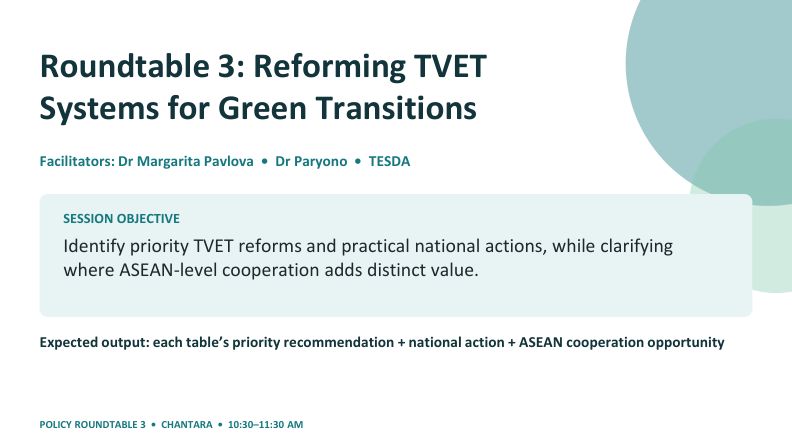
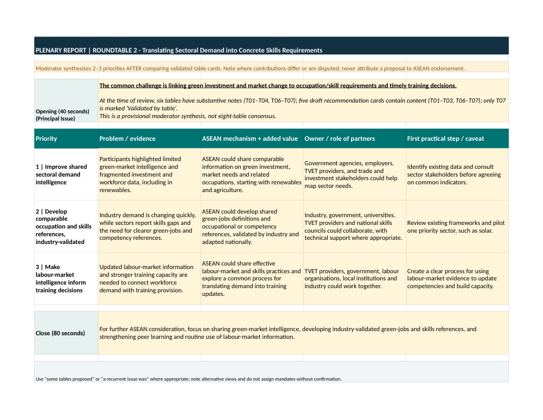
Additional report-backs are now available: RT1 reports priorities, RT2 explicitly remains provisional (only T07 validated), and RT3 comprises a small participant poll. None is a formal adopted ASEAN decision.
Has Brunei's GERI readiness been assessed and validated?
The slide deck explicitly described Brunei institutional submissions as unvalidated. No country readiness score for Brunei is asserted here.
Generated from user-provided session records as of 20 October 2026. These two transcripts stop after the moderator returns the programme to the host. Formal closing remarks have now been supplied separately and added above.
07 · Final evidence reconciliation · 19–20 October 2026
The two-day verdict.
Seven new report-back and presentation PDFs now incorporated. Executive visuals above a fully referenced strategic assessment.
A green transition succeeds when investments generate demand; employers specify changing work; educators can deliver the skills; and people actually obtain safe, decent jobs.
01Investment creates demand; training alone does not.
Philippine closing remarks, ADB investment analysis and RT2 converge on the need to validate sector projects and firms before expanding courses. See D1-07; D2-L02 p1; formal closing transcript.
02Most work changes inside existing occupations.
GIZ distinguishes narrow green jobs from green-potential occupations; ILO proposes task-level intelligence. Green and digital capabilities should be planned together. See D2 GIZ/ILO slides and D2-L07 pp2–4.
03Institutional readiness is a full-system constraint.
TESDA covers standards, research, campus, culture and workplace links. GERI and RT3 identify trainer, curriculum and infrastructure bottlenecks. See TESDA p5–11; GERI; D2-L03 p2.
04Decent work belongs in the investment plan.
Social protection, safety, early social dialogue, income bridges and training access matter. Employer and worker evidence; Indonesia's Global Accelerator integrates these into transition policy. See D1-03–05, D2-L04 and D2-L05.
05Industry must co-design and co-invest.
RT1 recommends regular industry–government–TVET dialogue, shared demand data and qualifications updates. Employer organisations propose workplace feedback, capacity building and finance suitable for MSMEs. See D2-L01 pp8–10; D2-L04 p9.
06Regional tools should strengthen national decisions.
The ASEAN Secretariat places green jobs beside blue economy, energy, circularity and trade frameworks. Shared references and peer learning can help, without imposing identical national pathways. See D2-L06 pp2–8.
07Financing and accountability decide success by 2030.
EY highlights the unfunded worker transition and evaluates the need for policy impact—not training counts alone. Finance, responsibilities and verified employment outcomes must be tracked. See D2-L07 pp7–10 and host closing remarks.
Can partners share usable blue–green occupational and competency references?
Where can industry-connected research, specialist training and work placements produce real employment pathways?
What joint facilities or technical cooperation can close verified institutional gaps?
Evidence integrity. RT1 PDF cover states 20 June 2026 despite the October context; RT2 explicitly lacks multi-table validation; RT3 is a small poll. Indonesian social-insurance rates are country-specific. Brunei GERI country scores are not validated. EY's five recommendations are emerging synthesis, not a negotiated declaration. Original author rights remain unchanged.
Seven Day 1 PDFs + fifteen Day 2 PDFs, transcripts, roundtable results and the final two-day synthesis.
22 SOURCE PDFs · 226 PAGES
Foundational strategic analysisDay 1 strategic policy intelligence reportTwo distinct recorded sessions · five findings · proposed Brunei baseline. Separate from the seven slide decks.
Two ASR renderings of the same policy panel (approximately 15:57–17:05), followed by a separately supplied transcription of the formal closing remarks. Neither is a negotiated outcome communiqué.
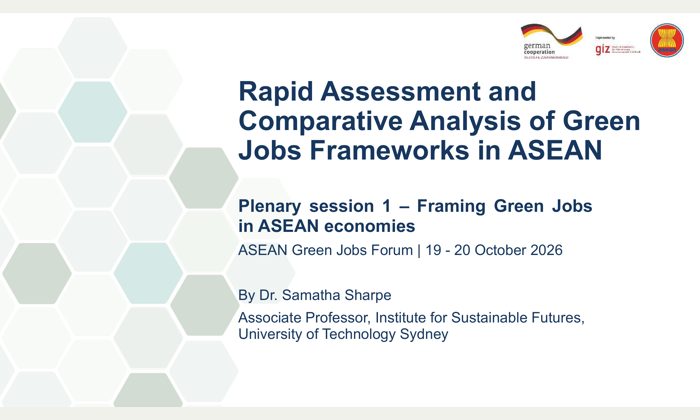
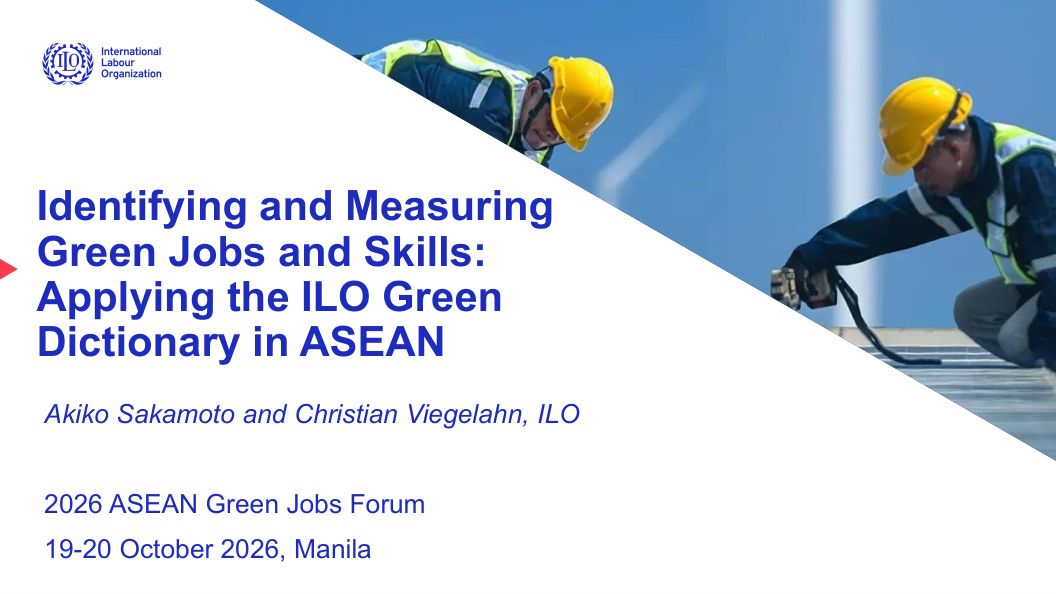
Rapid Assessment and Comparative Analysis of Green Jobs Frameworks in ASEAN
Dr Samatha Sharpe / GIZ / University of Technology Sydney
An assessment of national green-jobs policy frameworks across ASEAN.
D1-02Parallel 1·8 pages
Green Mobility, Green Jobs
Antonio Zara / VinFast Philippines
A company presentation on electric-vehicle adoption, the shift toward connected mobility, potential disruption of conventional auto jobs, and growing requirements in batteries, electronics, software, data and automation.
D1-03Parallel 2·4 pages
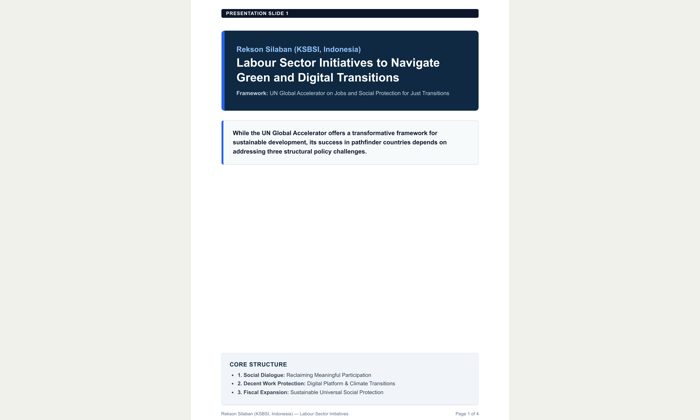
Labour Sector Initiatives to Navigate Green and Digital Transitions
Rekson Silaban / KSBSI, Indonesia
Argues for meaningful institutionalised social dialogue, protection for workers affected by green and digital shifts, and sustainable financing models for expanded social protection.
D1-04Parallel 2·6 pages
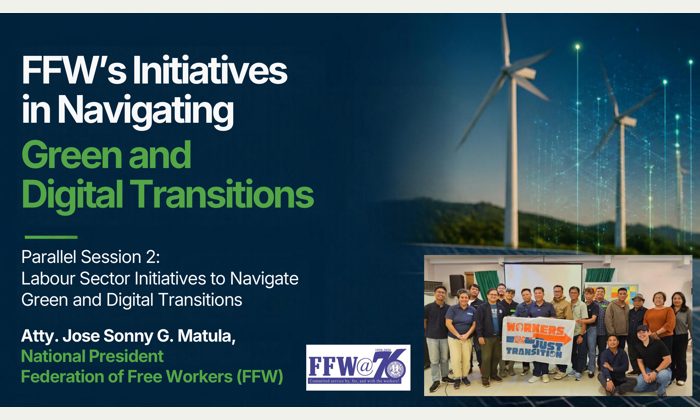
FFW’s Initiatives in Navigating Green and Digital Transitions
Atty Jose Sonny G. Matula / Federation of Free Workers (FFW), Philippines
A worker-centred view of just transition: decent jobs, security of income, training, social dialogue, negotiating fair redeployment and collective participation in transition decisions.
D1-05Parallel 2·9 pages
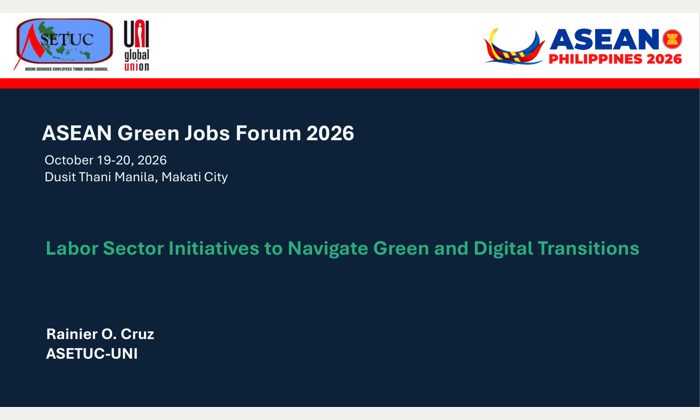
Labour Sector Initiatives to Navigate Green and Digital Transitions
Rainier O. Cruz / ASETUC–UNI
Highlights negotiated worker–employer transition plans, paid reskilling and redeployment, inclusive access, income bridges, occupational safety, and ASEAN-level exchange of tools and practices.
D1-06Parallel 3·9 pages
Cross-Sectoral Collaboration in Building the Workforce to Power Our Future
Monette S. Lasala / AboitizPower
Energy-sector examples combining digital twins, analytics, AI, drones and engineering operations.
D1-07Plenary 3·7 pages
Mobilizing Capital for Green Jobs: Examples from ADB
Alexander Tsironis / Asian Development Bank (ADB)
Project examples in low-carbon transport, resilient agrifood systems and solar/storage show how sector investments create occupations.
Check sharing rights
No presentations match these filters.
Permissions: This is a private working repository. These slides belong to their respective authors. The ADB presentation specifically displays an internal-sharing restriction; permission must be checked before redistribution or public publishing.
Day 2 · full documentary update15 Day 2 PDFs, including final report-backs · 1 worksheet · transcripts and analyses
SOURCES / PRIMARY
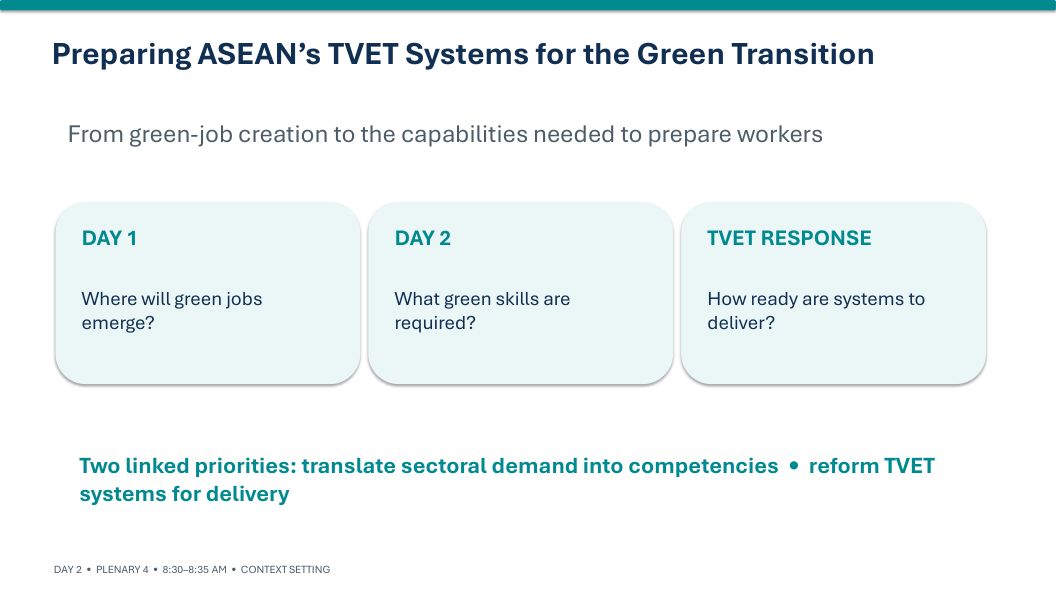
D2-P00 · Plenary 4 · 3P
Session Context: Preparing ASEAN TVET for the Green Transition
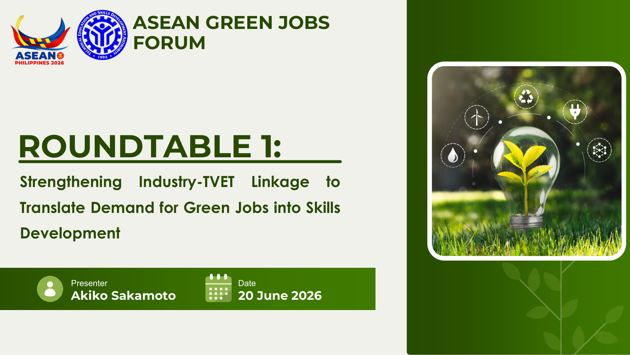
Document provenance: The Roundtable 1 cover appears to show a June date despite its inclusion in the 20 October set. The Roundtable 3 participant DOCX repeats blank templates. Retain original metadata but do not infer a different meeting date or completed consensus from these artefacts. Rights remain with original presenters.
Newly received final-session sources
7 PDFs · 61 pages · original presenters
D2-L01 · 11P
Roundtable 1 — Industry–TVET report-back
Akiko Sakamoto (presentation label) / Forum roundtable
RT1's document cover date reads 20 June 2026 and is preserved as supplied. RT2 is provisional; RT3 is a convenience poll. Presentation content and intellectual property belong to their authors.
09 · Decision preparation
From intelligence to action.
Proposed follow-up to the 20 October final-session synthesis, plus private field notes. No action listed here is an assigned departmental task.
Decision sequence · evidence to application
Compact decision roadmap
V
01 / VERIFY
Clean the evidence base.
Before using any statistics publicly, convert transcript findings into checked evidence.
Match transcript claims to slides when received
Keep Brunei GERI positions unpublished until validated
Separate speaker claims from verified findings
T
02 / TEST
Run a Brunei diagnostic.
Use a focused sector-based test rather than broad reform rhetoric.
Confirm employer/project demand
Check readiness of HEI/TVET delivery assets
Identify missing standards, trainers or facilities
A
03 / ACT
Take targeted questions into the Blue dialogue.
Use the upcoming forum to seek practical cooperation rather than general declarations.
Shared specialist facilities
Applied research and work-based learning
Regional skills observatories and taxonomies
Timing
Primary conclusion
Immediate use
Now
Evidence still provisional in places.
Validate before amplifying.
Use the 3 PM decks; confirm unresolved differences with presenters.
Internal briefing only.
Use as working intelligence, not final public reporting.
Next
Brunei needs a manageable entry point.
Use a pilot diagnostic.
Start with a narrow sector pathway rather than a whole-system launch.
Preparation for dialogue.
Frame the 27–28 October discussion around practical capability questions.
Later
Regional cooperation can deepen.
Scale what proves useful.
Taxonomies, vacancy analytics and readiness tools can mature over time.
Structured follow-through.
Move from forum insights to repeatable institutional practice.
CLOSING PANEL / STRATEGIC DECISION RULE
What should JPT do differently?
01Choose demandVerifiable sector projects
02Specify skillsActual occupations and tasks
03Audit readinessHEI / TVET capability
04Protect workersAccess, decent jobs, RPL
05Verify impactTraining → outcomes, not enrolment alone
Proposed analytical sequence. Any lead agencies, budget or timing are subject to official consideration and validation.
Field intelligence notes
Stored only in your browser · Export frequently
No server sync, authentication or backup. Do not enter confidential or personal information. Browser local-file storage can vary by browser.
My field notes0 saved
No notes recorded yet.
Green–Blue Futures · Private working edition v0.21 · Prepared for internal policy analysis, not an official ASEAN or Government of Brunei publication. Event materials and slides are subject to original author rights. The Green Jobs Forum and the higher education Blue Economy dialogue are thematically connected here by an independent analytical framework; formal inter-dialogue coordination is not established by the supplied documents.
GREEN / BLUE FUTURESMINISTRY-LEVEL WORKING STRATEGY BRIEF
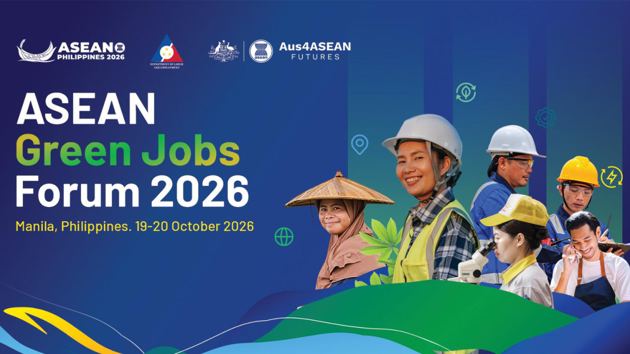
ASEAN GREEN JOBS FORUM 2026Executive briefing modeExecutive synthesis
EXECUTIVE PRESENTATION01 / 06
01 / EXECUTIVE SYNTHESIS
The test is delivery.
Green ambitions become quality jobs only when economic demand and workforce capacity are planned together.
01 / DAY 1INVESTMENTEnterprise activity + credible hiring demand
02 / DAY 2CAPABILITYOccupation tasks + HEI / TVET response