GREEN / BLUE FUTURESPOLICY INTELLIGENCE · WORKING EDITION
01 / CONNECTED POLICY ARCHITECTURE

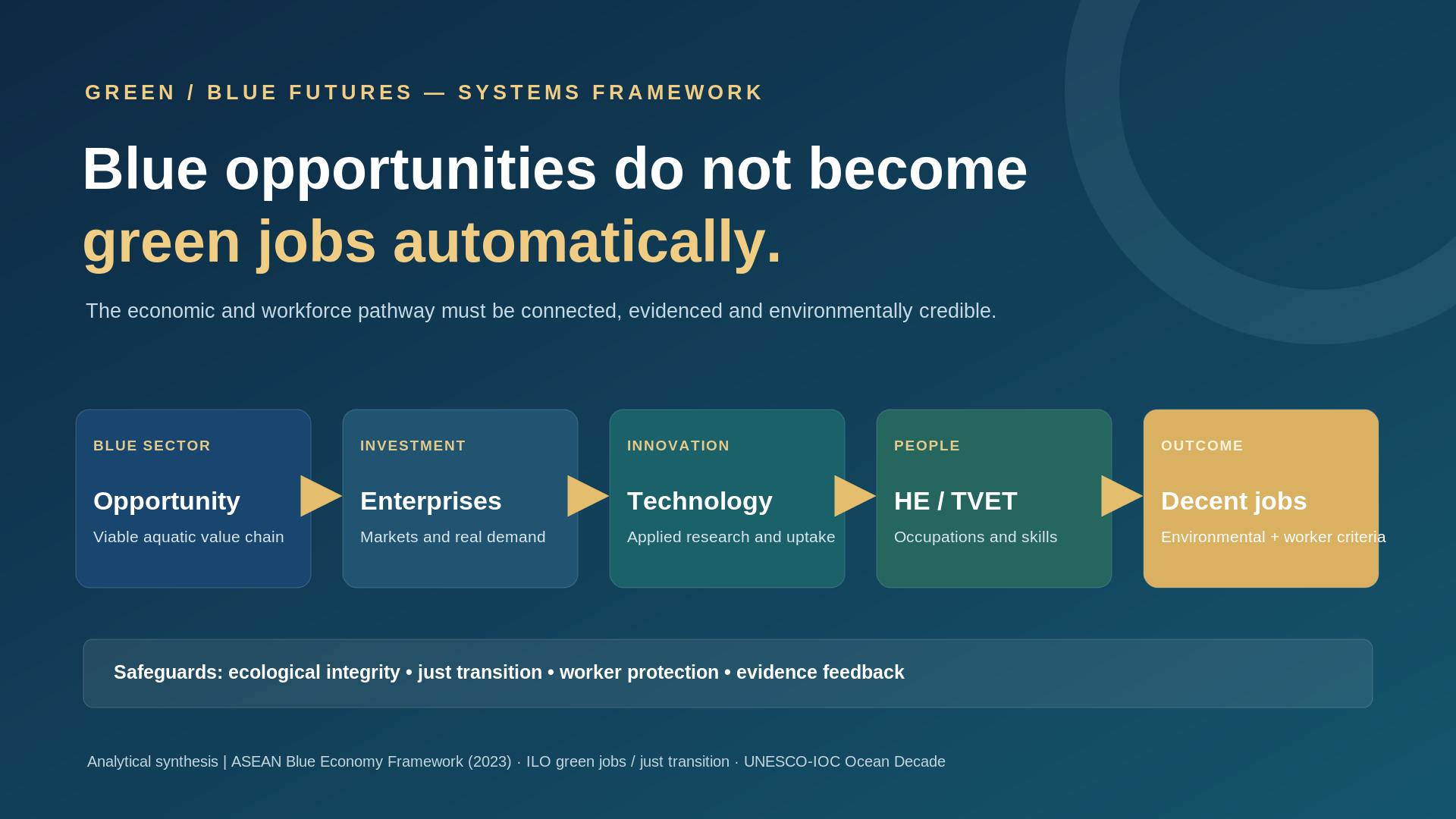
From blue opportunities to decent work and sustainable prosperity.

One coherent, research-grounded framework linking aquatic economic opportunities, investment, research, innovation, future skills, decent green–blue jobs and national development.

ASEAN BLUE ECONOMY FRAMEWORK · 2023GREEN JOBS / JUST TRANSITION · ILOBRUNEI / WAWASAN 2035
22 OCT 2026 · SOURCE-LINKED WORKING SYNTHESIS
01 / THE INTEGRATED SYSTEM

The Green–Blue Nexus

Sustainable blue economy × green-transition criteria × decent work
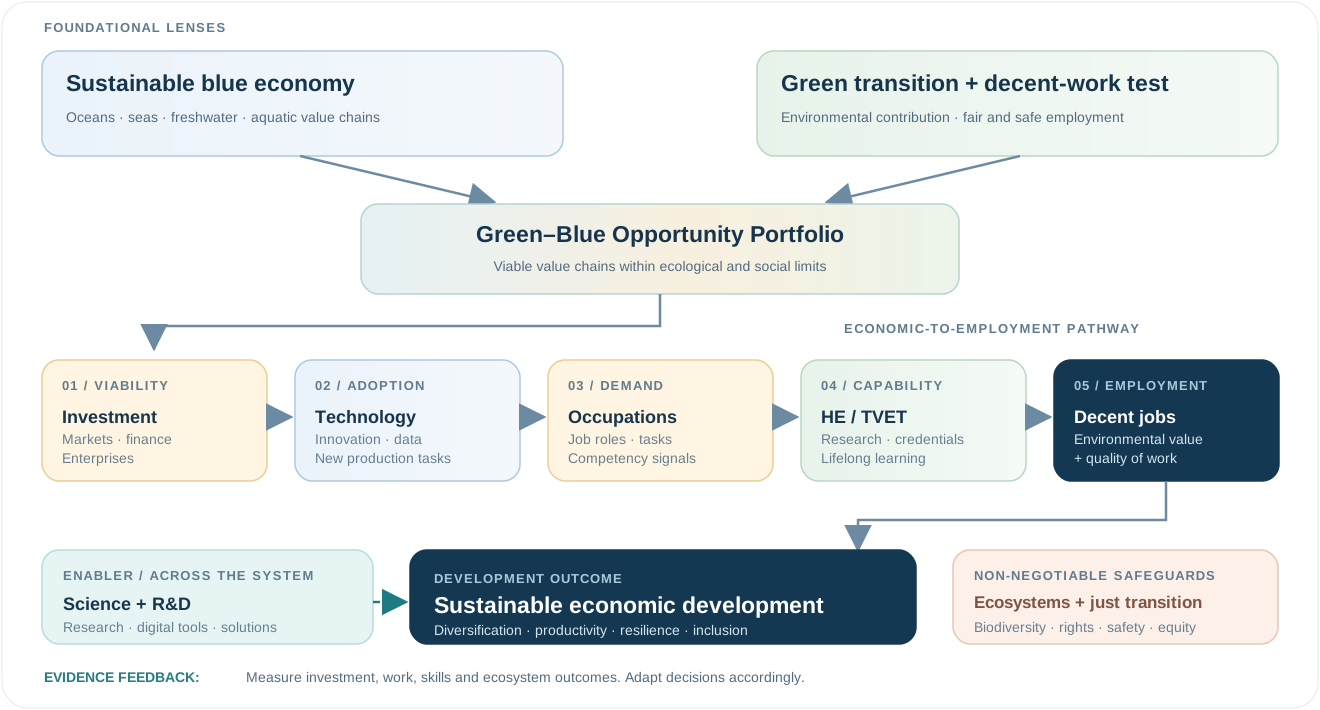
Integrated Green–Blue Nexus systems map. Sustainable blue-economy and green-transition lenses converge on blue-green opportunities, passing through investment, technology, occupational demand, higher education and TVET to decent jobs and sustainable economic development; supported by science, safeguards and evidence feedback.

Interpretation: The arrows describe a testable policy-delivery hypothesis, not a promise that investments necessarily create green employment. A sustainable blue opportunity must meet ecological tests, and associated jobs must meet environmental and decent-work criteria.

SECTOR / RESOURCE LENS

What the blue economy tells us

ASEAN's 2023 framework covers oceans, seas and freshwater resources, including existing activities and emerging value chains. It identifies opportunities for value creation through an inclusive and sustainable approach.

ENVIRONMENTAL + LABOUR LENS

What the green-jobs test adds

The ILO defines green jobs as decent work that contributes to preserving or restoring the environment. Being employed in a maritime or aquatic sector is not, by itself, enough to qualify as green employment.

OPERATIONAL DEFINITION · PROPOSED

The three-test intersection

Blue-economy value chain+
Environmental contribution+
Decent-work conditions✓

A proposed screening rule for this portal—not an official statistical classification adopted by ASEAN or Brunei. The environmental test must consider the actual activity and its impact; the employment test must cover job quality.

02 / VERIFIED ASEAN REGIONAL ARCHITECTURE

Five Blue Outcomes. One development system.

Official ASEAN implementation plan 2026–2030 · proposed Green–Blue Futures crosswalk

ASEAN's implementation plan organises its desired Blue Outcomes around five forms of capital. They operate together: investment relies on infrastructure, people and cooperation, while aquatic ecosystem health sets long-term conditions for all four.

Financial↔Physical↔Human↔Social↔Natural

How to read this: The five outcomes are ASEAN's regional framework. The green-jobs tests, JPT implications, and indicative measures below are this portal's analytical mapping—not a set of national targets or endorsed institutional commitments.

FINANCIAL CAPITAL

Grow blue assets, investment and trade

ASEAN Blue Outcome

Make viable, responsible investment and market access possible for aquatic value chains.

Green-jobs and JPT interpretation

Employment link: Verify firms, demand, financing and projects before promising jobs. JPT lens: Use investment pipelines and employer signals to prioritise skills and research cooperation.

Possible evidence: projects reaching financial close; participating employers; verified vacancies. No Brunei values are asserted.

PHYSICAL CAPITAL

Develop blue infrastructure and technology

ASEAN Blue Outcome

Improve enabling assets, cleaner systems, monitoring and technology adoption.

Green-jobs and JPT interpretation

Employment link: Technology creates and changes technical tasks, not necessarily net new jobs. JPT lens: Match engineering, data and technical training to actual adopted systems.

Possible evidence: operational installations, adoption rates, staff competencies, environmental performance.

HUMAN CAPITAL

Develop blue skills, knowledge and abilities

ASEAN Blue Outcome

Develop the workforce, researchers, institutional knowledge and inclusive learning opportunities.

Green-jobs and JPT interpretation

Employment link: Demand-aligned credentials and workplace learning enable entry and transition. JPT lens: Audit programmes, research teams, laboratories, and occupational gaps first.

Possible evidence: graduate pathways, placements, validated qualifications, employers reporting skill gaps.

SOCIAL CAPITAL

Forge relationships, trust and collaboration

ASEAN Blue Outcome

Enable shared action among governments, industry, institutions and communities.

Green-jobs and JPT interpretation

Employment link: Just transition requires social dialogue, inclusion and worker protection. JPT lens: Structure purposeful ASEAN–EU applied partnerships and qualification cooperation.

Possible evidence: joint deliverables, worker participation, collaborative curricula, mobility with outcomes.

NATURAL CAPITAL

Safeguard blue resources and ecosystems

ASEAN Blue Outcome

Protect the marine and freshwater ecosystems on which long-term opportunity depends.

Green-jobs and JPT interpretation

Employment link: Conservation, restoration and cleaner production create environmentally relevant tasks. JPT lens: Support marine science, biodiversity and environmental monitoring capacity.

Possible evidence: validated habitat or water-quality indicators, pollution trends, monitoring coverage.

PROPOSED GREEN–BLUE FUTURES SYNTHESIS

Five capitals enable sustainable blue activity—green jobs must still pass a separate test.

Capital development may increase productive activity, but job counts, decent-work conditions and environmental benefits cannot be inferred automatically. Treat the ILO decent-work test and ecological safeguards as independent checks across the five outcomes.

Official ASEAN Implementation Plan ↗
03 / FROM OPPORTUNITY TO EMPLOYMENT

Begin with the economy, not the course.

Six linked decision gates; each needs evidence before proceeding
01 · OPPORTUNITY

Sustainable sector

Identify viable aquatic value chains and ecological constraints.

02 · INVESTMENT

Markets & enterprises

Confirm buyers, finance, firms and feasible projects.

03 · INNOVATION

Technology uptake

Find solutions, adoption partners and new productive tasks.

04 · DEMAND

Jobs & tasks

Document roles, skill profiles and recruitment realities.

05 · CAPABILITY

HEI & TVET

Assess programmes, research, credentials and placements.

06 · RESULTS

Decent green jobs

Verify employment, job quality and environmental performance.

ENABLING ENGINE

Innovation, ocean science and digital technology

Technology and R&D may improve environmental performance and productivity or reshape occupations. Partnerships should track who adopts research and which real problems are solved, not merely publications or cooperation agreements.

CONSTRAINT + FEEDBACK

Ecology, worker protection and monitoring

Safeguards include ecosystem health, biodiversity, resource use, rights, safety, inclusion and social dialogue. Measured economic, labour and environmental results should reshape investments, curricula and research.

Illustrative case: sustainable aquaculture

A viable aquaculture enterprise could adopt water-quality sensors, cleaner production, disease monitoring and digital controls. These might generate tasks for technicians, laboratory staff and analysts. However, neither the enterprise demand nor the number of resulting jobs in Brunei has been validated. The example illustrates the pathway—it is not a documented pipeline.

04 / NATIONAL RELEVANCE

Brunei: capability alignment under Wawasan 2035

Align economic diversification, future skills, livelihoods and ecological resilience
MATLAMAT 1

Educated, highly skilled people

Map existing higher education, technical skills, research infrastructure and professional pathways against real occupations.

MATLAMAT 2

Quality of life

Test employment quality, workforce inclusion, environmental security and the resilience of communities.

MATLAMAT 3

Dynamic, resilient economy

Investigate diversification opportunities based on knowledge, productivity, technology and sustainable enterprise.

POTENTIAL JPT / HEI / TVET CONTRIBUTION

Four practical workstreams

01 · Map economic and labour demand

Engage industry and relevant ministries on plausible investments, changing tasks and workforce demand.

02 · Audit present institutional capability

Map programmes, equipment, research strengths, graduates and qualifications across public HEIs and TVET.

03 · Design targeted cooperation

Prioritise ASEAN–EU projects where technology transfer, specialist facilities or applied research fill a verified gap.

04 · Establish outcomes and governance

Track research adoption, employer participation, employment quality and relevant ecological indicators.

PROPOSED BRUNEI POLICY POSITION

Partnerships should solve specific constraints.

For a smaller national system, regional research platforms, mobility and specialist programmes may be more efficient than duplicating every capability domestically. Prioritise credible demand, measurable outcomes and cross-agency ownership.

Return to the main Strategy Command →

Governance boundary: No blue-economy priority sector, new HEI course, lead-agency arrangement, pilot or national employment figure is claimed to have government approval in this analysis.
SOURCE-LINKED INSTITUTIONAL SCOPING · 22 OCTOBER 2026

Brunei's potential institutional contribution

Verified public evidence versus areas requiring direct confirmation with HEI focal points

This is a capability-scoping matrix, not a readiness scorecard. It records publicly documented activities at each institution, possible blue-economy applications and what JPT still needs to validate. No employment forecast or formal institutional commitment is implied.

InstitutionPublicly documented evidencePotential green–blue contributionValidation needed
UBDVerified research activityMarine Ecosystem and Climate Change group: biodiversity, environmental monitoring, mariculture and habitat recovery. UBD research group ↗Marine baselines, ecosystem indicators, aquaculture-related scientific research and specialist regional research networks.Active project inventory, facilities, capacity, industry uptake and collaboration readiness.
UTBVerified research activityGreenTeXS research centre covers environmental sustainability, renewable energy, aquaculture and climate resilience; 2026 event examined AI/IoT for marine monitoring. UTB centres ↗Engineering, AI/IoT, applied monitoring, energy efficiency, digital marine systems and technology transfer.Live pilots and partners, equipment, adoption evidence and relevant programme capacity.
IBTEVerified 2026 programmes2026 programmes include Marine Engineering, Nautical Studies, deck and engine ratings at Brunei Maritime Academy, plus NTec Aquaculture. IBTE 2026 list ↗Technical maritime operations, vessel skills, aquaculture technicians, safety and industry-based competency pathways.Enrolment and graduate numbers, employer demand, certification/recognition and curriculum greening.
PBTransferable capabilityOfficial 2026 programme announcement confirms Level 5 diploma provision across science and engineering, ICT and other schools. PB programmes ↗Possible applications in instrumentation, digital solutions, engineering, testing, business and technical support for blue value chains.Which current programmes specifically map to verified blue-sector tasks; no marine-specific programme is asserted here.
UNISSAAdjacent evidenceCurrent Master of Halal Science and Innovation (Research) provides a food/quality-related knowledge base; university publications discuss fisheries and aquaculture. UNISSA programme ↗Potential quality assurance, halal supply-chain research, seafood value addition and sustainability-related ethics/governance.Current fisheries curricula, staff expertise, facilities and industry activities; publication is not proof of an operational blue-economy programme.

Reading rule: “Verified” refers only to what the linked official institution sources actually document. The potential-contribution and validation columns are JPT-facing hypotheses, not approved assignments. The list is intentionally not ranked.

JPT / PRE-DIALOGUE ACTION

Request a compact evidence return from HEI focal points.

Collect: relevant programme and research activity → personnel and facilities → industry partner → occupational demand evidence → potential ASEAN–EU cooperation → indicative outcome measure. Use the same fields across all five institutions to avoid incomparable submissions.

05 / ASEAN–EU POLICY DIALOGUE · 27–28 OCTOBER 2026

From discussion to cooperation with outcomes

Evidence-linked questions; intended to prepare Brunei contributions, not presume the meeting's conclusions

The upcoming dialogue is designed to strengthen higher education and TVET partnerships, blue and green talent, research and mobility. The practical opportunity is to seek specific, accountable cooperation that connects the five Blue Outcomes with verified sector demand and ecological safeguards.

Official event agenda: Nuffic / SCOPE-HE event page ↗. The intended Manila Policy Brief is a future output, not an adopted recommendation as of 22 October 2026.

FINANCIAL + HUMAN CAPITAL / LABOUR DEMAND01 · How can we tie a skills partnership to genuine blue-sector investment and hiring demand?

Why it matters: A skills programme is not proof of job creation. Evidence to seek: named enterprise needs, occupational tasks, investment and recruitment pipeline, and commitment to placements. Possible outcome: an employer-validated competency map or jointly supervised training placement.

ASEAN implementation reference ↗
PHYSICAL + NATURAL CAPITAL / INNOVATION02 · Which applied research collaborations would produce measurable gains in ecosystem health?

Evidence to seek: agreed environmental problem, joint methods, data governance, instrumentation, baseline and adopter. Possible outcome: an operational environmental-monitoring pilot with a clear reporting protocol.

UBD marine research example ↗
HUMAN CAPITAL / QUALIFICATIONS03 · Which blue-economy competencies need regional recognition rather than duplicated national provision?

Evidence to seek: sector-specific task standards, professional requirements, assessment methods, portability and industry demand. Possible outcome: a shared short course, qualification mapping or targeted micro-credential proposal, subject to competent authorities.

Policy Dialogue objectives ↗
SOCIAL CAPITAL / JUST TRANSITION04 · How will partners include workers, small enterprises and coastal communities in shaping skills solutions?

Evidence to seek: worker and community consultation, social dialogue, fair access, safety and relevant support measures. Possible outcome: a stakeholder-inclusive partnership protocol.

ILO Just Transition Guidelines ↗
NATURAL CAPITAL / SUSTAINABILITY TEST05 · What minimum ecological safeguards must a proposed blue-economy pilot demonstrate?

Evidence to seek: ecosystem baseline, resource-use effects, climate vulnerability, pollution risks and monitoring responsibility. Possible outcome: a joint environmental screening checklist tied to research and project decisions.

ASEAN framework ↗
ALL FIVE OUTCOMES / MEASUREMENT06 · Can the Manila Policy Brief specify how partnerships will be measured beyond signed agreements?

Evidence to seek: baseline indicators across investment, technology uptake, talent, partnerships and ecosystems. Possible outcome: indicators that distinguish activities, outputs and verified employment or ecological outcomes.

Five outcome explanation ↗
BRUNEI / SMALL-STATE COOPERATION07 · Where should Brunei specialise domestically, and where should it share advanced research infrastructure regionally?

Evidence to seek: existing laboratories, unique expertise, cost, specialist demand, regional facilities and mobility mechanisms. Possible outcome: a small number of feasible co-research or staff-development tracks rather than parallel programmes in every institution.

UTB institutional example ↗
BRUNEI / SECTOR-TO-JOBS TRANSMISSION08 · How can JPT, industry and the relevant ministries jointly verify that new technical skills lead to decent jobs?

Evidence to seek: employer-validated skills, vacancies, work placements, graduate and worker outcomes, job safety and environmental contribution. Possible outcome: shared evidence template and cross-agency feedback cycle—not an unapproved national programme.

ILO green-jobs test ↗

Suggested Brunei intervention · 45–60 seconds

“The challenge is not simply to develop more blue-economy skills. It is to connect investment, innovation and genuine occupational demand with the capabilities of higher education and TVET, while ensuring that economic opportunities translate into decent work and measurable environmental outcomes. For Brunei, targeted ASEAN–EU cooperation in applied research, industry-linked training and recognised competencies could help bridge specialist capability gaps. How might we design partnerships around verified demand and common outcome indicators?”

06 / VERIFIABLE FOUNDATION

Evidence register

Official references where available. Internet required only to open external sources.
PRIMARY · ASEAN 2023ASEAN Blue Economy FrameworkSets the cross-sector regional blue-economy definition, including freshwater.Open primary/official source ↗PRIMARY · ASEAN 2026–2030ASEAN Blue Economy Implementation PlanOfficial 2026–2030 implementation plan, structured around five Blue Outcomes linked to financial, physical, human, social and natural capital.Open primary/official source ↗PRIMARY · ILOWhat is a green job?Provides the environmental contribution plus decent-work definition.Open primary/official source ↗PRIMARY · ILOJust Transition GuidelinesProvides the social dialogue, labour policy and protection dimensions.Open primary/official source ↗OFFICIAL · ASEAN 2026ASEAN Green Jobs Forum Secretariat messageDocuments the forum emphasis on implementation, skills, investment and decent work.Open primary/official source ↗PRIMARY · ASEANJoint Statement on Green JobsRegional principles concerning inclusive workforce transition and skills.Open primary/official source ↗OFFICIAL · UNESCO-IOCUN Ocean DecadeFoundation for ocean science, applied research and innovation.Open primary/official source ↗OFFICIAL · WORLD BANKPROBLUE ProgrammeAligns ecosystem health, blue economy development, jobs and communities.Open primary/official source ↗PRIMARY · BRUNEIWawasan Brunei 2035 – Goal 3Diversification and a dynamic, resilient, knowledge-intensive economy.Open primary/official source ↗OFFICIAL · BRUNEIRKN12 launch contextNational investment, workforce and environmental sustainability context.Open primary/official source ↗UPLOADED · PRE-MEETING SOURCE4th ASEAN–EU Blue Economy Higher Education DialogueAgenda and expected outputs for 27–28 October 2026. Not evidence of adopted meeting outcomes.Read supplied concept note ↗OFFICIAL · ASEAN BLUE WEALTHFive Blue Outcomes / capitalsExplains financial, physical, human, social and natural capital and their relationship to the ASEAN Blue Economy Implementation Plan.Open verified source ↗OFFICIAL · ASEAN–EU HIGHER EDUCATION4th Policy Dialogue · Manila, 27–28 October 2026Outlines the forthcoming meeting objectives, HE/TVET role and intended Manila Policy Brief.Open verified source ↗OFFICIAL · UBDMarine Ecosystem and Climate Change groupResearch activity involving marine biodiversity, monitoring, mariculture and habitat reclamation.Open verified source ↗OFFICIAL · UTBGreenTeXS and research centresResearch expertise covering green technology, aquaculture and sustainability.Open verified source ↗OFFICIAL · IBTE2026 full-time programme listVerified programmes at Brunei Maritime Academy and NTec Aquaculture.Open verified source ↗OFFICIAL · PB2026 academic programme overviewDocuments programme provision across engineering, ICT and related schools; blue-sector mapping remains to be established.Open verified source ↗OFFICIAL · UNISSAHalal Science and Innovation (Research)Documents a relevant research programme; seafood supply-chain application is a potential, not a proven blue-economy programme.Open verified source ↗

Claim classification

Verified: official definitions, named regional plans and national strategic goals. Forum-derived: the 19–20 October conclusions held in the original source library. Analytical: the integrated causal model, framework arrows, Brunei intervention and proposed workstreams. Unavailable: any outcomes of the future 27–28 October dialogue.